The Reserve Bank of India has finally made the move markets had been preparing for.
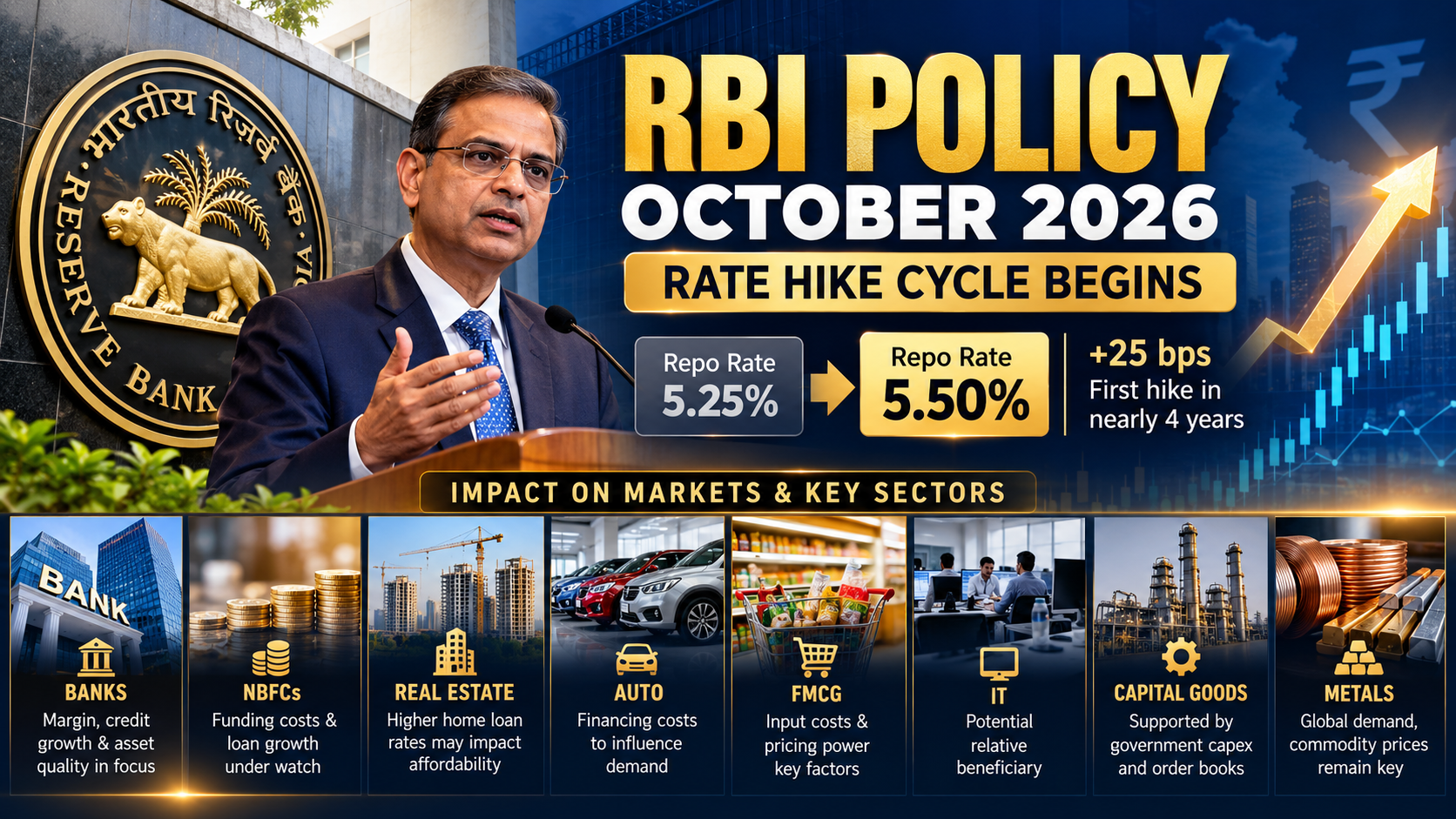
On 7 October 2026, the RBI Monetary Policy Committee raised the repo rate by 25 basis points from 5.25% to 5.50%, marking the first increase in nearly four years.
But investors should not look at today's policy simply as a 25-bps rate hike.
The bigger message is the change in the direction of India's monetary cycle.
For much of 2025 and early 2026, the conversation was about supporting growth, transmitting earlier rate cuts and maintaining adequate liquidity. Today, the debate has shifted decisively toward inflation management, crude oil, currency stability and the cost of capital.
That transition could have important implications for equity markets—and particularly for Banks, NBFCs, Real Estate, Auto and highly leveraged businesses.
RBI's Policy Journey: The Last Three Quarters Tell the Story
To understand today's decision, investors need to look beyond a single MPC meeting.
June 2026 — Pause and Observe
In June, RBI kept the repo rate unchanged at 5.25%.
At that time, the central bank projected FY27 GDP growth of around 6.6% and CPI inflation of 5.1%.
RBI was already acknowledging the risks arising from global energy prices, supply-chain disruptions and higher input costs.
However, demand-side inflation pressures remained relatively contained.
The message was effectively:
There are inflation risks, but there is no immediate need to tighten monetary policy.
RBI therefore preferred to allow the previous monetary easing to work its way through the economy.
August 2026 — Inflation Vigilance Increases
The August policy again kept the repo rate unchanged at 5.25% and retained the neutral stance.
But the economic picture had started changing.
RBI upgraded its FY27 GDP growth forecast to approximately 6.7%, while CPI inflation was projected at around 5.0%.
More importantly, inflation was expected to remain elevated during the second half of the financial year.
The August message was therefore subtly different:
Growth remains resilient, but inflation risks require greater vigilance.
This was important.
A central bank facing weak growth has limited freedom to raise rates.
A central bank facing strong growth and rising inflation, however, has considerably more room to tighten.
October 2026 — RBI Finally Acts
Today's 25-bps increase to 5.50% completes that transition.
The policy narrative over the past few quarters can now be summarised as:
Rate Cuts → Pause → Inflation Vigilance → Rate Hike
Why has RBI changed direction?
Because several inflationary and macroeconomic risks are now converging.
Higher crude oil prices are increasing India's imported inflation risk. Global bond yields remain elevated. The rupee has been under pressure. Food-price risks have increased following an uneven monsoon, while domestic economic activity remains sufficiently resilient to absorb some monetary tightening.
The most important point is this:
RBI is no longer primarily concerned about stimulating demand. It is increasingly concerned about protecting price and macroeconomic stability.
Why Crude Oil Matters So Much for India
Investors sometimes treat crude as simply another commodity.
For India, it is much more than that.
A sustained increase in crude can trigger a chain reaction:
Higher Crude → Higher Import Bill → Current Account Pressure → Rupee Weakness → Imported Inflation → Higher Interest Rates
Higher oil prices also raise transportation, logistics, manufacturing and input costs across industries.
Therefore, crude can simultaneously affect:
- Inflation
- Corporate margins
- Consumer purchasing power
- Government finances
- The rupee
- Interest rates
- Equity valuations
This is why investors should continue monitoring crude even after today's RBI announcement.
The RBI can increase interest rates to control second-round inflation, but it cannot produce crude oil or eliminate a geopolitical supply shock.
That distinction is important when evaluating how aggressive the future tightening cycle could become.
What Does the 25-bps Rate Hike Mean for the Equity Market?
A rate hike is not automatically bearish for equities.
Markets discount expectations well before policy announcements. A 25-bps increase was already widely anticipated.
The more important question now becomes:
Is this a one-time adjustment—or the beginning of multiple rate hikes?
If inflation moderates and crude stabilises, today's increase could represent a relatively limited normalisation.
But if crude remains elevated, the rupee continues weakening and inflation broadens, markets may begin pricing another RBI hike.
And that changes the valuation framework for equities.
Banking: Higher Rates Are Not Necessarily Bad News
Banking is the first sector investors normally associate with monetary policy.
But the relationship between interest rates and bank profitability is more complicated than simply:
Rate hike = negative for banks.
Higher policy rates can allow banks to reprice floating-rate loans and improve asset yields.
But deposit costs eventually rise as well.
The real question therefore becomes:
Which reprices faster—assets or liabilities?
Banks with strong CASA franchises, disciplined deposit pricing, healthy liquidity and high-quality loan books should be relatively better positioned.
Banks aggressively competing for expensive deposits may experience greater pressure on net interest margins.
Investment View
I would remain selective rather than broadly negative on banking.
Strong liability franchises and asset quality become increasingly important in a rising-rate environment.
NBFCs: Funding Costs Become Critical
The impact could be more significant for NBFCs.
Unlike large banks, many NBFCs do not have access to a large pool of low-cost CASA deposits.
They depend more heavily on:
Bank borrowings + bonds + market funding
As interest rates rise, their marginal cost of borrowing can increase.
The important question becomes:
Can the NBFC pass the additional borrowing cost to customers without affecting loan growth or asset quality?
Companies with diversified funding, strong capital adequacy, high-yielding loan books and good underwriting standards should be better positioned.
Investment View
Selective and cautious.
Funding structure may become just as important as loan growth.
Real Estate: The Easy-Money Tailwind Is Weakening
Real estate is one of the most rate-sensitive sectors.
Higher repo rates eventually translate into higher borrowing costs and potentially higher home-loan EMIs.
That reduces affordability.
But the impact will not be uniform across the sector.
Premium housing can remain relatively resilient because buyers are generally less sensitive to small changes in mortgage rates.
Affordable and mid-income housing can be more vulnerable.
Developers with:
Low debt + strong cash flows + high pre-sales + established brands
should therefore be better positioned than highly leveraged developers.
Investment View
Move from a broad sector approach toward quality developers with strong balance sheets.
Automobile: Financing Costs Matter Again
A large proportion of automobile purchases are financed.
Higher borrowing costs therefore affect consumer affordability.
Two-wheelers and entry-level passenger vehicles could be relatively more sensitive, while premium vehicles may prove more resilient.
Commercial vehicles will remain more closely linked to economic activity, freight demand, infrastructure investment and fleet utilisation.
Investment View
The RBI hike is a mild negative, but product cycles and demand fundamentals remain more important than a single 25-bps increase.
FMCG: Watch the Reason Behind the Rate Hike
For FMCG businesses, today's repo-rate increase itself is not the biggest problem.
The inflation behind the increase is.
Higher crude can increase:
Packaging + Transportation + Logistics + Raw Material Costs
Food inflation can simultaneously reduce household purchasing power.
That creates pressure from both sides—higher costs and potentially weaker discretionary demand.
Investment View
Prefer businesses with strong brands and pricing power that can pass higher costs to consumers without materially damaging volumes.
IT: A Potential Relative Beneficiary
Indian IT companies have relatively limited direct sensitivity to domestic interest rates.
A weaker rupee can also provide some earnings support to export-oriented technology businesses.
This doesn't automatically make IT bullish.
US technology spending, global growth and client discretionary budgets remain the dominant variables.
However, if domestic rates rise while the rupee remains weak, IT could become a relative outperformer compared with domestic rate-sensitive sectors.
Capital Goods, Defence & Infrastructure
These sectors could remain relatively resilient.
Government capex, defence spending, power infrastructure, railways and large industrial order books are not directly dependent on consumer borrowing rates.
The distinction investors should make is leverage.
A company with a ₹20,000 crore order book and low debt is very different from a company with a similar growth story but an overleveraged balance sheet.
Investment View
Continue favouring companies with:
Strong order books + execution capability + positive cash flows + manageable debt.
Metals: RBI Is Not the Primary Driver
Metal stocks require a different framework.
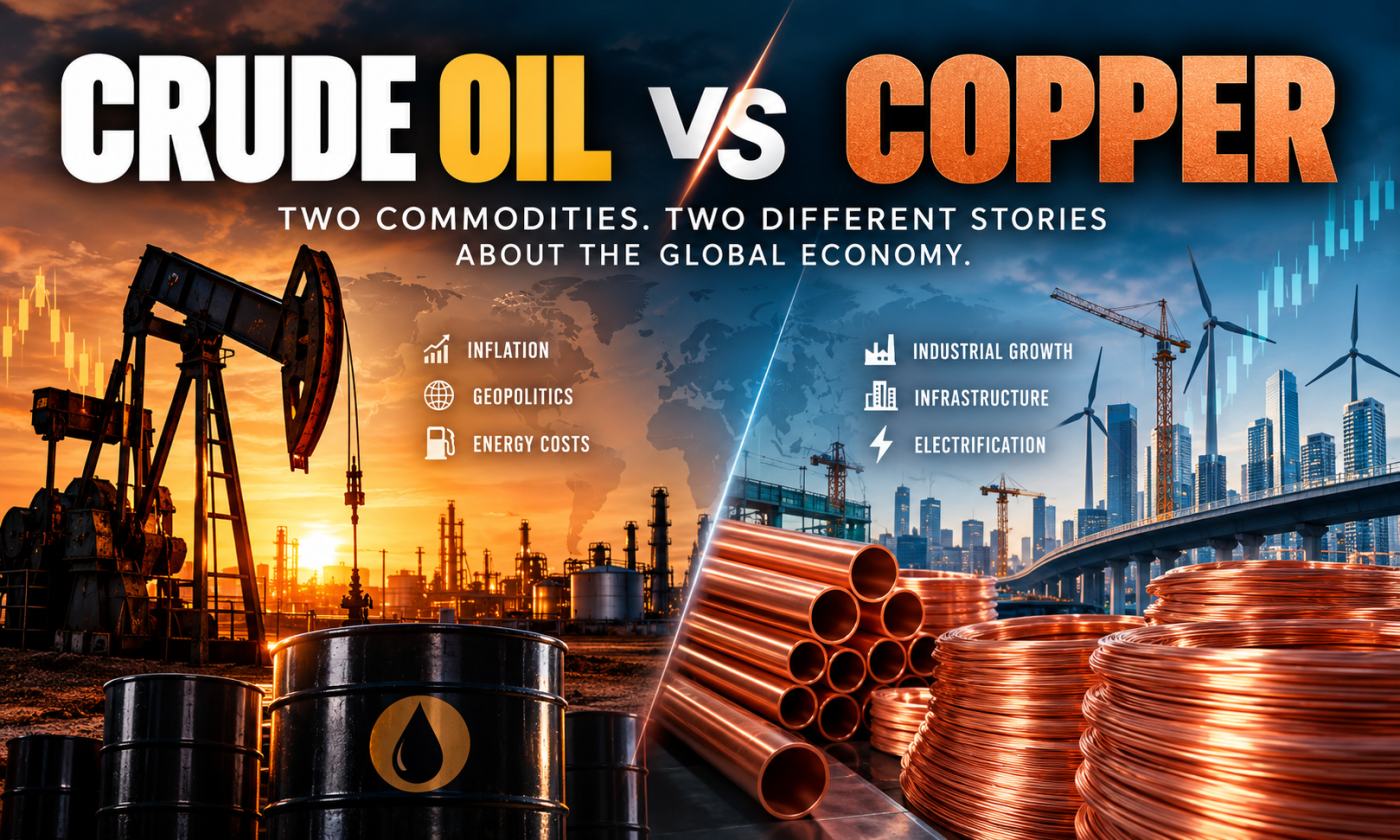
The major variables are:
China + Global Growth + US Dollar + Commodity Supply + Infrastructure + Energy Transition
Copper remains particularly interesting because structural demand is emerging from:
- Power infrastructure
- Renewable energy
- Electric vehicles
- Grid modernisation
- AI data centres
However, a prolonged global tightening cycle can eventually weaken cyclical commodity demand.
Therefore, metals should be evaluated commodity-by-commodity rather than simply through the RBI policy lens.
Disclaimer: This article is for educational and informational purposes only and should not be considered investment advice.