
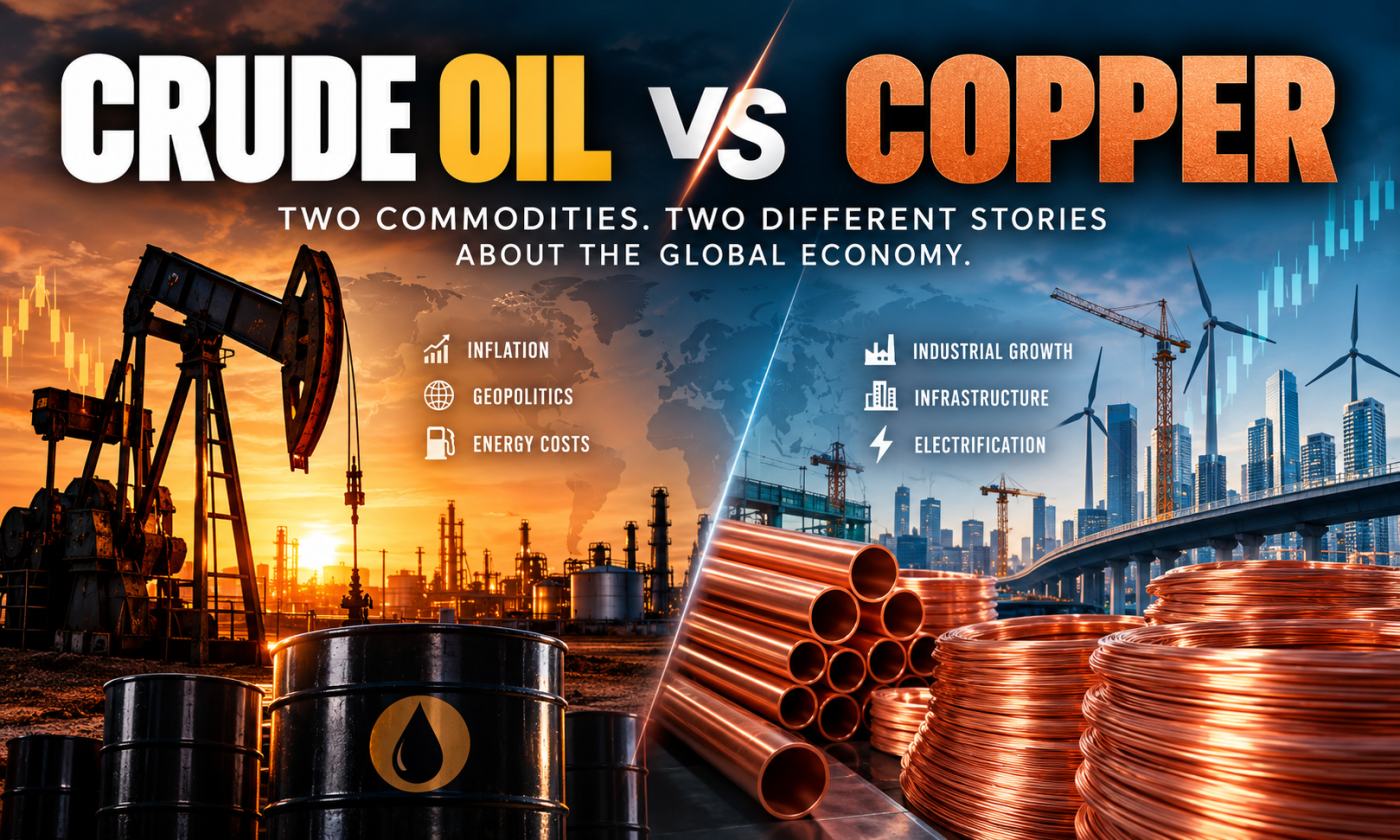
Crude oil tells us about the cost of running the global economy. Copper tells us about the demand for building its future.
Both are among the world's most important industrial commodities. Yet their price movements often reflect very different economic forces.
For investors, understanding the relationship between crude oil and copper can provide valuable insights into inflation, industrial growth, interest rates and equity-market opportunities.
1. Crude Oil: The Inflation and Geopolitical Indicator
Crude oil is deeply connected to transportation, manufacturing, petrochemicals and global energy consumption.
Its prices are influenced by OPEC+ production decisions, geopolitical tensions, global inventories, economic activity and the US dollar.
When crude oil prices rise sharply, the implications can include:
- Higher transportation and logistics costs.
- Increased inflationary pressure.
- Pressure on corporate profit margins.
- Higher import bills for oil-dependent economies such as India.
- Potential benefits for upstream oil producers.
The important distinction: Rising crude prices do not always signal strong economic growth. Sometimes they reflect supply disruptions or geopolitical risks rather than improving demand.
2. Copper: The Industrial Growth Indicator
Copper is often called Dr. Copper because of its close relationship with industrial activity.
Unlike crude oil, copper demand is strongly linked to long-term infrastructure investment, construction, electrical equipment, renewable energy and electrification.
Copper is essential for:
- Electric vehicles and charging infrastructure.
- Power transmission and distribution networks.
- Data centres and electrical infrastructure.
- Renewable energy installations.
- Industrial machinery and construction.
When copper prices rise alongside stronger manufacturing activity and industrial orders, it can indicate improving economic demand.
However, copper prices can also rise because of mining disruptions, constrained inventories or speculative positioning.
3. Crude Oil vs Copper: What Their Price Movements Tell Investors
| Market scenario | Possible economic interpretation |
| Crude (Up) Copper (Up) | Broad commodity demand, reflation or supply pressure |
| Crude (Up) Copper (Down) | Energy supply shock, inflation and growth concerns |
| Crude (Down) Copper (Up) | Improving industrial outlook with easing energy costs |
| Crude (Down) Copper (Down) | Potential slowdown in global demand |
These are analytical interpretations, not fixed market rules. Currency movements, inventories and supply disruptions can change the signals.
4. Why the Crude Oil–Copper Relationship Matters for India
India is particularly sensitive to movements in both commodities.
Higher crude oil prices can increase the country's import burden, influence inflation expectations and create cost pressures for aviation, paints, chemicals and logistics companies.
Copper presents a different opportunity.
India's investment in power infrastructure, renewable energy, electrical equipment and manufacturing can support long-term copper consumption.
This creates an interesting investment framework:
Lower crude oil + stronger copper demand can be a favourable combination for India's industrial economy.
It potentially means reduced energy-related cost pressures alongside stronger infrastructure and manufacturing activity.
5. Which Indian Stock Market Sectors Should Investors Watch?
| Commodity trend | Sectors to monitor |
| Rising crude oil | Upstream oil exploration and production |
| Falling crude oil | Aviation, paints, logistics and selected chemicals |
| Rising copper demand | Cables, electrical equipment, power infrastructure |
| Rising copper input prices | Manufacturers with limited pricing power |
| Strong copper and weak crude | Capital goods, industrials and infrastructure |
For copper-linked opportunities, companies such as Hindustan Copper, Hindalco Industries, Polycab India and KEI Industries deserve research attention, although their earnings sensitivity differs substantially.
Higher copper prices can benefit producers but may squeeze the margins of downstream users if cost increases cannot be passed on.
6. What Should Investors Monitor Next?
Instead of analysing crude oil and copper independently, investors should track their relative performance alongside economic indicators.
The copper-to-oil price ratio is one useful research indicator. A rising ratio means copper is outperforming crude oil, but it does not necessarily mean copper itself is rising.
Investors should combine this signal with China's manufacturing PMI, global industrial production, OPEC+ supply decisions, the US dollar, commodity inventories and bond yields.
This helps distinguish a genuine improvement in industrial demand from a temporary commodity-price move.
Final Investment Perspective
The next major opportunity in commodities may not come from predicting which metal or energy product will rise the most.
It may come from understanding why copper and crude oil are moving differently.
Crude oil represents the energy cost of today's economy.
Copper represents a major component of the infrastructure required for tomorrow's economy.
When their price trends diverge, investors should pay attention. That divergence can reveal important changes in growth expectations, inflation pressures and sector leadership.
At Realexus Capital Advisors, we believe commodity analysis is not just about trading prices. It is about identifying economic shifts before they become obvious in corporate earnings.