
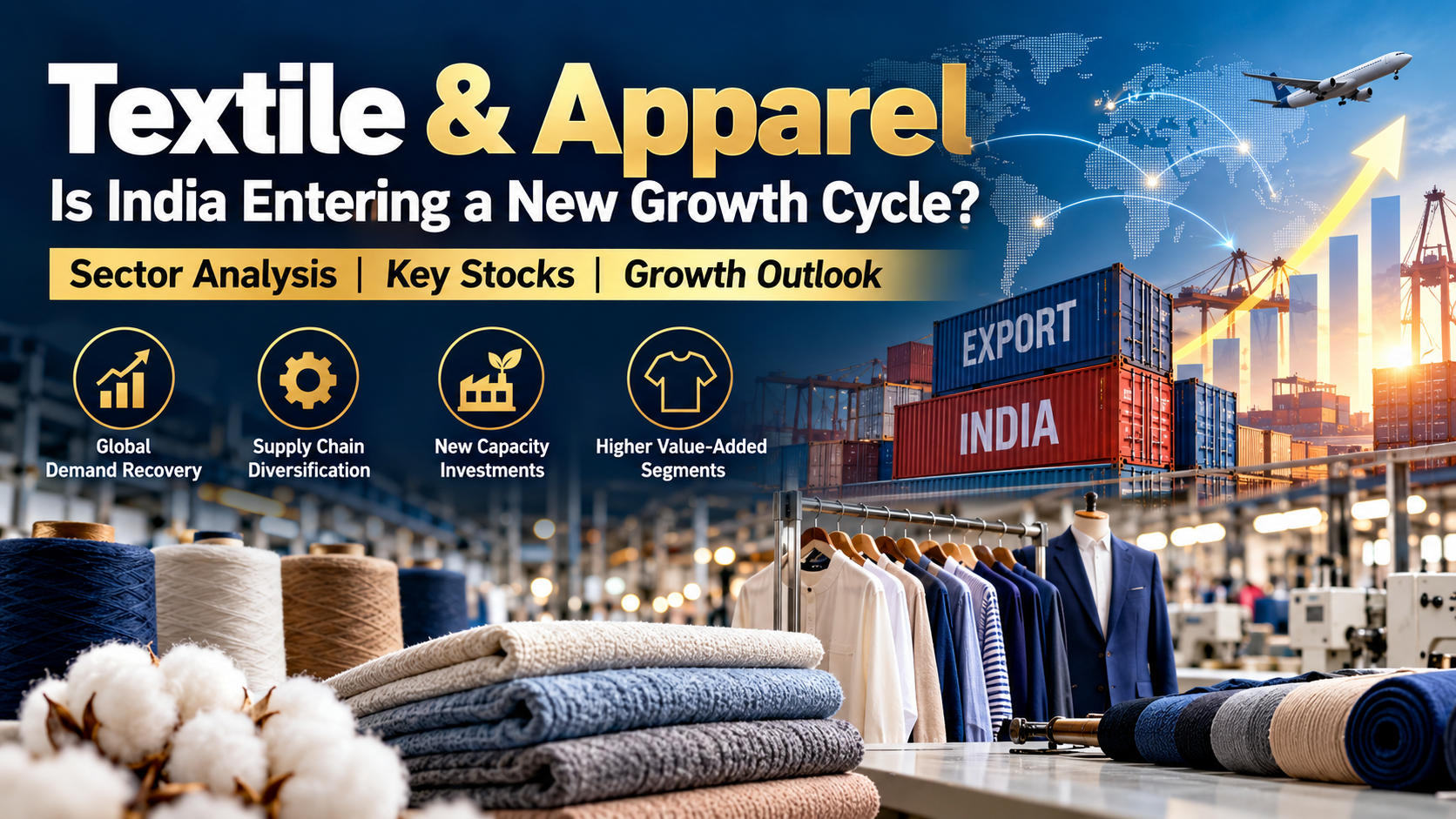
India’s textile and apparel industry could be entering an interesting phase as global demand gradually recovers and global supply chains continue to diversify beyond China.
After a period of weak discretionary demand and inventory correction across major markets, the sector is seeing improving demand visibility. For Indian textile companies, this could create an opportunity for higher capacity utilisation, stronger order inflows and improved earnings visibility.
1. Sector Outlook: Why Textile & Apparel Could Be Interesting
Global demand is gradually recovering
The US and European markets remain critical for Indian textile exporters. As retailer inventories normalise and discretionary consumption improves, global apparel demand could gradually strengthen.
A recovery in international orders can benefit Indian manufacturers through:
- Higher export orders
- Better capacity utilisation
- Improved operating leverage
- Better revenue visibility
- Potential margin recovery
India’s supply-chain opportunity
Global companies continue to look for diversified manufacturing bases. India has several structural advantages, including a strong cotton ecosystem, large manufacturing capacity and competitive production costs.
Government initiatives such as PM MITRA, PLI and ATUFS, along with potential trade agreements and tariff realignment, could further improve India's competitiveness.
The opportunity is particularly significant in value-added textile segments, rather than simply traditional commodity textile manufacturing.
The sector is entering a new investment cycle
Several established textile companies are investing in additional capacity across:
- Garments
- Home textiles
- Man-made fibre (MMF)
- Technical and specialty textiles
- Value-added fabrics
- Automation and modernisation
The important point is that the next phase of growth may be driven not only by higher volumes but also by premiumisation and better product mix.
2. Stocks to Watch in the Textile & Apparel Basket
Welspun Living
Welspun Living provides exposure to the home textile segment and the global export market. A recovery in US and European demand, combined with better capacity utilisation, could support the company's growth outlook.
Arvind
Arvind offers exposure across textiles and apparel, with an established manufacturing ecosystem. Its positioning across fabrics, garments and branded/value-added businesses makes it an interesting company to track as the textile cycle improves.
Pearl Global
Pearl Global is primarily positioned toward garment manufacturing and global apparel supply chains. The company's exposure to international brands makes global apparel demand and order recovery important variables for investors.
Indo Count
Indo Count is another important player in the home textile/export segment. Recovery in global home-furnishing demand and operating leverage could become key earnings drivers.
Gokaldas Exports
Gokaldas Exports provides exposure to India's growing garment-export opportunity. Increasing global sourcing from India and expansion in apparel manufacturing could support its long-term growth potential.
3. What Could Drive the Sector?
The textile sector's performance over the next 12–24 months could depend on five major factors:
Global demand → Export orders → Capacity utilisation → Margins → Earnings growth
Investors should therefore track not only revenue growth but also:
- Export order book
- Capacity utilisation
- EBITDA margins
- Debt levels
- New capacity commissioning
- Customer diversification
- US/Europe demand
- Working-capital requirements
4. Key Risks
The opportunity does not come without risks.
- Global demand: A slowdown in the US or Europe could delay the recovery.
- Currency: Export-oriented companies remain sensitive to INR movement.
- Raw materials: Cotton and other input-cost volatility can affect margins.
- Competition: India faces competition from Bangladesh, Vietnam, China and other manufacturing destinations.
- Execution: Large capacity expansions require significant capital and successful execution.
Therefore, while the sector outlook appears constructive, stock selection remains critical.
5. Investor Perspective
The textile industry may be moving from a volume-driven recovery toward a value-added growth cycle.
The combination of global supply-chain diversification, improving international demand, government incentives and fresh capacity investments creates a favourable structural backdrop for selected Indian textile and apparel companies.
However, investors should not treat the entire sector uniformly. Companies with strong balance sheets, export visibility, efficient capacity, better product mix and sustainable margins could potentially emerge stronger from the next cycle.
Bottom Line
Textile & Apparel is no longer simply a traditional export story.
The next opportunity could come from India's transition toward higher-value garments, technical textiles, MMF, branded products and integrated manufacturing.
This article is for educational/informational purposes only and should not be construed as investment advice. The stock prices and portfolio weights above are based on the provided presentation dated 23 June 2026 and may have changed subsequently. Investors should conduct their own due diligence and consider their risk profile before investing.