
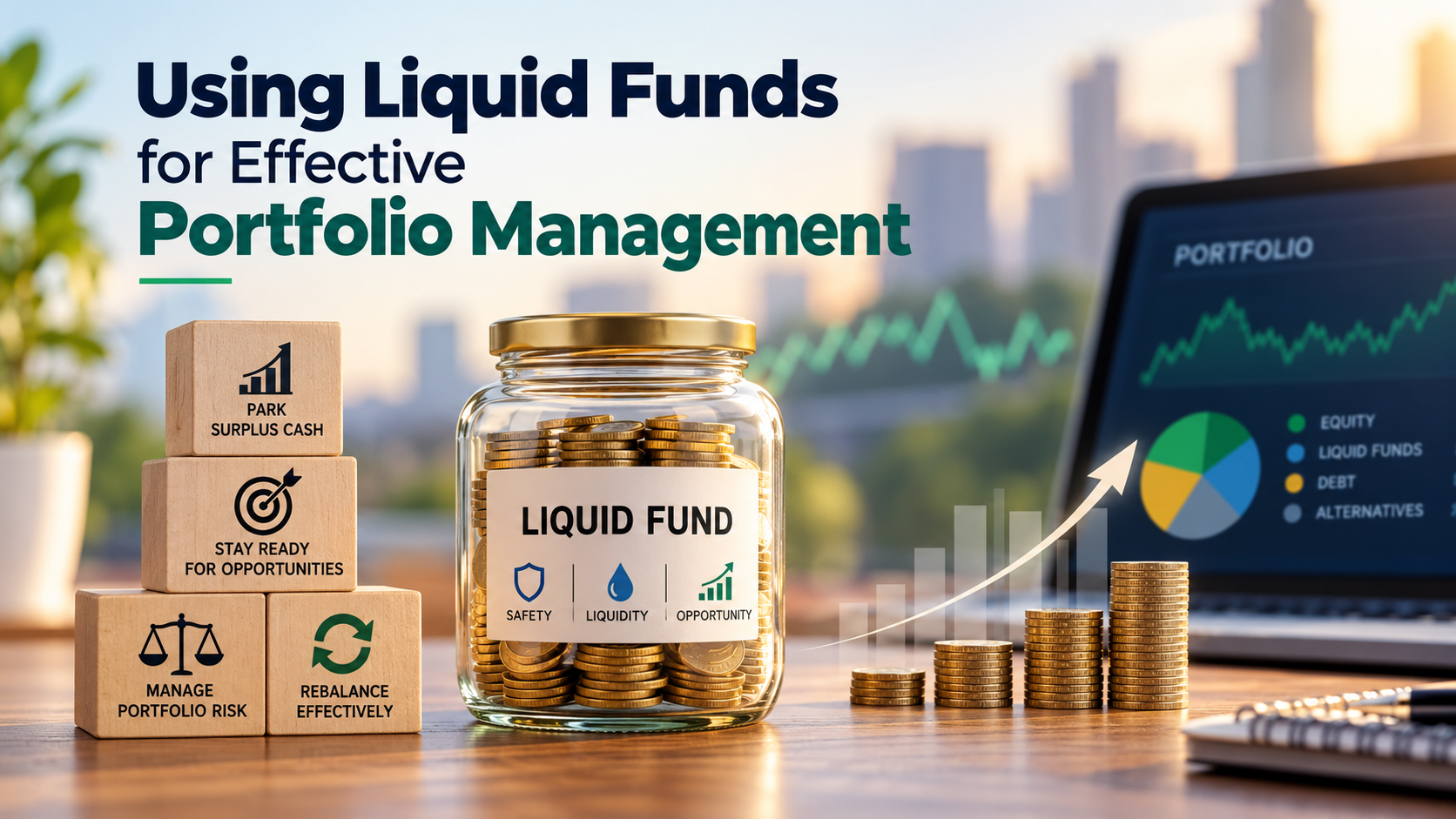
A successful portfolio is not just about selecting the right stocks. It is also about managing cash intelligently.
Most investors focus on finding multibagger stocks, identifying market bottoms and maximizing returns. But one important aspect of portfolio management often gets ignored: Where should you keep your money when you are waiting for the right investment opportunity?
Keeping excess money idle in a savings account may not be the most efficient approach. On the other hand, investing every rupee in equities leaves little flexibility during market corrections.
This is where liquid mutual funds can play an important role.
1. What are liquid funds?
Liquid funds are debt mutual funds that invest in short-term money market and debt instruments with maturities of up to 91 days, including Treasury Bills, Commercial Papers and Certificates of Deposit.
Their primary objectives are liquidity, relatively low interest-rate sensitivity and income generation.
Unlike equity funds, liquid funds are generally used for short-term cash management rather than long-term wealth creation.
Important: Liquid funds are not bank deposits. Their NAV can fluctuate, returns are not guaranteed, and they carry credit, interest-rate and liquidity risks.
2. Why should equity investors consider liquid funds?
Imagine an investor managing a portfolio of ₹25 lakh.
The investor believes that the long-term outlook for equities is positive, but current valuations do not offer attractive risk-reward opportunities.
Instead of deploying the entire ₹25 lakh immediately, the investor could consider the following illustrative allocation.
Illustrative ₹25 lakh portfolio allocation
Equity investments
Liquid funds
Other defensive assets
Illustrative allocation, not a universal recommendation
| Equity investments | ₹17,50,000 |
| Liquid funds | ₹5,00,000 |
| Other defensive assets | ₹2,50,000 |
The ₹5 lakh allocated to liquid funds serves two purposes: it remains available for future investment opportunities while potentially earning a return during the waiting period.
The appropriate cash allocation will depend on market conditions, investment horizon, financial goals and risk tolerance.
3. How to use liquid funds strategically in portfolio management
Strategy 1: Build an opportunity fund
Market corrections often create attractive opportunities in fundamentally strong companies.
However, investors who are fully invested may be forced to sell existing holdings to buy new opportunities.
A liquid fund allocation can help maintain purchasing power for future investments.
For example, an investor may deploy part of their liquid fund holdings when selected stocks reach attractive valuations, rather than investing merely because the overall market has declined.
Strategy 2: Deploy capital gradually through STP
A Systematic Transfer Plan (STP) allows investors to transfer money periodically from one mutual fund scheme to another, subject to scheme availability.
Suppose you have ₹12 lakh available for equity investment but want to avoid investing everything at once.
You could initially park the amount in a liquid fund and transfer ₹1 lakh every month into a suitable equity mutual fund over 12 months.
This approach helps stagger market entry, although it does not guarantee superior returns. Transfers are treated as redemptions from the source fund and may trigger capital gains tax and applicable exit loads.
Strategy 3: Manage profits after a strong market rally
When an equity portfolio rises significantly, its allocation to equities can become higher than intended.
Instead of allowing concentration and risk exposure to increase indefinitely, an investor can periodically rebalance.
For example, if a portfolio's target equity allocation is 70% but market appreciation pushes it to 82%, part of the gains may be shifted into liquid funds or other defensive assets.
This helps maintain portfolio discipline without requiring the investor to predict the exact market top.
Strategy 4: Maintain liquidity during uncertain markets
During periods of elevated valuations, earnings uncertainty or global macroeconomic risks, liquid funds can provide a temporary allocation for capital that investors do not wish to deploy immediately.
The purpose is not to predict every correction.
It is to ensure that investors have flexibility when attractive opportunities emerge.
4. How much can idle cash potentially earn?
Consider an investor keeping ₹5 lakh in a liquid fund for six months.
ILLUSTRATIVE RETURN CALCULATOR
Investment amount: ₹5,15,000
Assumed annual return: 6.0%
Holding period: 6 months
Illustrative earnings: ₹15,000
Estimated fund value: ₹5,15,000
Simple annualized return illustration, before tax and any charges. The assumed rate is not a current market quote or guaranteed yield. Actual NAV-based returns will vary.
The important point is not just the income earned. The investor also retains access to capital for future opportunities, subject to redemption timelines.
5. What investors should check before choosing a liquid fund
| Parameter | What to evaluate |
| Credit quality | Preference for high-quality underlying securities |
| Expense ratio | Lower costs help preserve short-term returns |
| Portfolio maturity | Short maturity and limited interest-rate sensitivity |
| Liquidity | Redemption settlement and applicable cut-off times |
| Exit load | Liquid funds generally have graded exit loads during the first seven days |
| Tax efficiency | Post-tax returns relative to other cash-management options |
Liquid funds commonly offer redemption settlement around T+1 business day, subject to applicable scheme rules. Some offer instant redemption facilities with limits. Investors should not assume immediate access to the entire balance.
6. The Realexus portfolio management perspective
At Realexus Capital Advisors, we believe that portfolio management should focus on three important decisions:
- When to invest: Deploy capital when valuations and business fundamentals justify the risk.
- When to rebalance: Reduce excessive exposure when portfolio allocations move away from the investment plan.
- Where to keep unallocated capital: Consider liquid funds and other suitable short-term instruments rather than allowing unnecessary cash to remain idle.
A liquid fund allocation is not necessarily a bearish market call. It can simply reflect disciplined capital allocation.
Conclusion: Cash is also a portfolio position
Investors often believe that staying fully invested is the only way to create wealth.
But investing successfully requires both conviction and flexibility.
Equities can create long-term wealth. Liquid funds can help manage short-term liquidity. Together, they can support a more disciplined portfolio strategy.
The objective is not to maximize the return on every rupee at every moment. It is to allocate capital efficiently while remaining prepared for opportunities and risks.
For a portfolio allocation review, visit realexuscapital.com.